The European Accessibility Act: What It Means for Your Website
Since June 2025, many businesses selling online to EU consumers must have accessible websites. Who is covered, what “accessible” means and a…
Read article
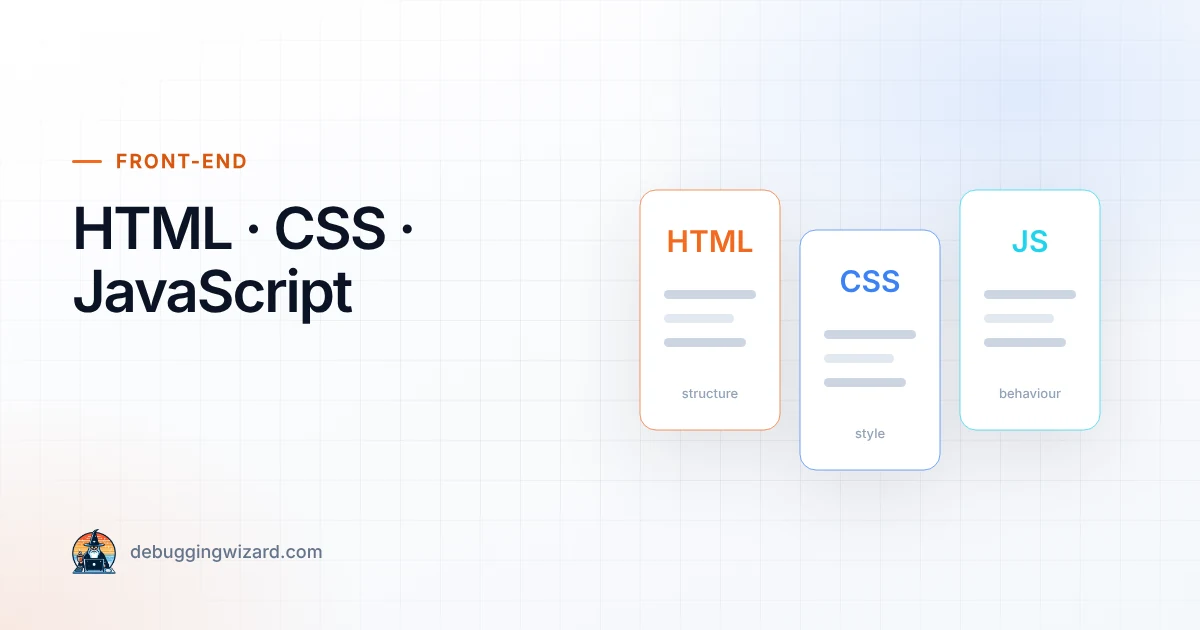
If you’re just starting out in front-end development, you’ve probably heard these three terms thrown around a lot: HTML, CSS, and JavaScript. They’re the core technologies of the web, and every website or web app you’ve ever used relies on them.
But what do they actually do? Let’s break it down with simple examples.
Think of HTML (HyperText Markup Language) as the skeleton of a website. It defines the structure and content: headings, paragraphs, images, links, forms, basically, what’s on the page.
👉 Example:
<h1>Hello, World!</h1> <p>This is my first website.</p> <img src="cat.jpg" alt="A cute cat" />
🔑 Key takeaway: HTML is the content and structure, nothing more. Without it, there’s no web page.
If HTML is the skeleton, then CSS (Cascading Style Sheets) is the clothes and makeup. CSS makes a page look good. It controls colors, fonts, layouts, and even animations.
👉 Example:
h1 { color: blue; font-family: Arial, sans-serif; } p { font-size: 18px; line-height: 1.5; }
With CSS, the boring black-and-white HTML suddenly looks polished and professional.
🔑 Key takeaway: CSS is what makes websites beautiful and responsive.
Now that we have structure and style, it’s time to make things move. JavaScript (JS) is the brain of a website. It allows users to interact with the page: clicking buttons, filling forms, toggling dark mode, or loading new content without refreshing.
👉 Example:
document.querySelector("button").addEventListener("click", () => { alert("You clicked the button!"); });
With JavaScript, websites transform from static pages into interactive applications (think online shopping carts, social media feeds, or live chats).
🔑 Key takeaway: JavaScript brings websites to life.
Imagine building a house:
Many beginners jump straight into frameworks like React or Next.js. But without a solid grasp of HTML, CSS, and JavaScript, those frameworks can feel overwhelming.
Learning these three first will:
HTML, CSS, and JavaScript are the holy trinity of front-end development. Once you understand what each one really does, you’ll see how they work together to create the web you use every day.
Start small: build a personal website with just HTML and CSS. Then sprinkle in JavaScript to add interactivity. Step by step, you’ll move from beginner to confident developer.
Founder & Lead Engineer at Debugging Wizard. Writes about web development, email engineering and keeping business tech running smoothly.
Since June 2025, many businesses selling online to EU consumers must have accessible websites. Who is covered, what “accessible” means and a…
Read articleSo, you want to become a front-end developer? Great choice! Front-end development is one of the most exciting and in-demand fields in tech right…
Read articleOne of the most important skills for beginner front-end developers is learning how to build responsive websites, pages that look great on desktop,…
Read articleTell us what’s slowing you down, we’ll reply within one business day with a clear plan.